When I reviewed the previous set in this series, I’m fairly sure I called it my favourite release from Big Finish of 2022. It was a fantastic set of really well explored ethical dilemmas in increasingly creative settings, with some of the best character work the company has put out in recent years. Naturally I was very excited to hear this third, and I assume final, set from the series. There’s been a bit of a departure from the episodic formula of the previous two sets, now choosing to tell a serialised story with Rose and new companion Danni (played by Em Thane) trying to find a way to get Rose back home and escape the Anti-life that is ravaging Danni’s universe. Now was this as good as that second set? Yes, and it might even be better in quite a few regards.
The general thoughts going through the Big Finish side of the Doctor Who fandom when it was announced Ruth Madeley would be included as a new character in the 60th Anniversary Specials, is that Hebe Harrison would be written out of the audio series.This has happened before with audio companions’ arcs being altered due to what was going on on television, C’rizz being the foremost example.The expectation going into Purity Unbound was that Hebe would have to leave, but surprisingly that doesn’t happen in the final story, there are still more adventures to tel with this TARDIS Team and honestly the set is all the better for it.The four box set story arc has been something in my eyes with its ups and downs, the second installment being the rockiest and the wait between sets not often helping matters.Purity Unbound is the high point of the arc, mainly because the writers have found their way to a consistent theme and conclusion to this saga, using each story as a way to explore the aberrations to the timeline (and further aberrations) in different and interesting ways.Jacqueline Rayner and Robert Valentine are joined by Mark Wright in scripting this final installment, all three writers keying in on the character journeys in particular, especially when concluding this story.It should be noted that this is a story arc about a dictator heavily enforcing a eugenics program based on disability which is most explicit in this set so this review may be discussing themes that could be triggering for some.For context, I am coming to this review from the perspective of someone who is physically disabled.Continue reading →
Big Finish Productions’ third installment of their 60th anniversary celebratory series, Once and Future, has been released and puts degenerating Doctor into his Seventh incarnation, played by Sylvester McCoy for A Genius for War.A Genius for War is interesting because the TARDIS is intercepted so the Doctor can go on a mission for the Time Lords led by the General and Veklin, played by Ken Bones and Beth Chalmers respectively, as Davros, played by Terry Molloy, has an offer for the Time Lords.The TARDIS being taken by the Time Lords means that this is an episode that feels more like a side step for the series, and as such Jonathan Morris is allowed to tell a complete Time War story in one hour, however, there is some oddities with the characterisation of the Doctor.Past Lives characterised the Fourth Doctor as not the Fourth Doctor due to the Doctor being a future Doctor in the body of the Fourth Doctor, but The Artist at the End of Time altered the characterisation so the Fifth Doctor acted as the Fifth Doctor.Jonathan Morris doesn’t quite take either approach, A Genius for War blending the portrayal to play to McCoy’s strengths but also feel as if it was rewritten for a different Doctor.This is certainly a possibility as Morris could easily have pitched this as a War Doctor story, the War Doctor on Big Finish is at least similar in the types of stories he has to the Seventh Doctor, so the rewrites while extensive wouldn’t have been as complicated as say rewriting the story for the Fifth Doctor or Eighth Doctor for instance.Morris’ script makes the Doctor take charge of the mission to find Davros and then blends several past and future stories into a single hour.
Star Cops is now, unbelievably, three series into its audio revival – not too shabby for a show which only managed one television run during the summer of 1987.
Winning a small but devoted fanbase, the show sprang from the mind of the late Doctor Who scribe and Blake’s 7 script editor Chris Boucher. He transplanted a police procedural to space, some thirty years in the future, providing clever detective stories with a sci-fi twist. No aliens, just humanity with all its foibles and failings. As the show’s lead Commander Nathan Spring is told in the series’ opener “Spacemen are ten-a-penny. What they need out there is a good copper.”
The High Frontier storyline comes to its conclusion in this box set with a trio from the show’s original television cast, David Calder (Nathan Spring), Trevor Cooper (Colin Devis) and Linda Newton (Pal Kenzy), alongside Phillip Olivier’s Paul Bailey who was created for audio. Together, the team are on the trail of an insidious organised crime gang known as The Collective, but they soon learn that their enemies are prepared to strike very close to home to thwart the investigation. Continue reading →
I ask, dear reader, to indulge me a moment before we get into this review proper for just a moment with a few pieces of context for this review.First and foremost, I am of the firm belief that the first series of Ninth Doctor Adventures should have ended as subtly implied with the Ninth Doctor going into the events of the television story Rose and the beginning of those adventures.Second, I am also of the belief that the Ninth Doctor especially is a character who works best when there is a companion or companion figure to be attached too.Finally, the third story of this set deals with the historical establishment of football leagues and I am an American, so take any of my takes on the history of that third episode with the largest pinch of salt you possibly can.Pioneers opens the third series of Ninth Doctor Adventures from Big Finish Productions and marks the first set in this range to not be released on vinyl as well as CD and download.This marks a very important shift for the style of these three episodes, mainly because they are not bound by the vinyl format of strictly being 45 minutes in total due to technical limitations, so these three episodes are expanded to an hour.While I personally prefer my Doctor Who stories to be generally longer than that, this jump in runtime really helps this set feel like each episode is expanded just enough to provide greater depth than previous releases had allowed.
Let’s take a moment to discuss integrating a theme into a story and how an author’s intent may perhaps become muddled by a production. Once and Future is the overarching name given to Big Finish Productions’ 60th Anniversary miniseries, planning to release monthly installments until the anniversary month and a coda in 2024. Like all anniversary specials the announcement came with a slew of guest stars and returning characters, with the premise being some incarnation of the Doctor has been attacked and is degenerating into previous incarnations of themself. This is the overarching plot of the miniseries, established at the start of Past Lives, Robert Valentine’s introductory story.
With the title and behind the scenes interviews, Valentine lays out this idea about anti-nostalgia and the pain of nostalgia, which is a laudable idea to inject into an anniversary story, especially one for a franchise that has been going for 60 years and shows no signs of stopping. It is especially prescient for an audio drama which is supplemental to the main show and whose company has had criticisms for an over reliance on nostalgia in recent years to stay in business.
This could have been an interesting examination of the need to keep referencing things and drawing people in as Valentine clearly intended, however, Past Lives just doesn’t do anything to explore those themes in its hour-long runtime. There are hints, Sarah Jane, played by Sadie Miller, is brought in right at the end of The Hand of Fear and the UNIT characters of Kate Stewart and Petronella Osgood, played by Jemma Redgrave and Ingrid Oliver respectively, right before The Day of the Doctor, is a clear choice to parallel characters from after and before their involvement with the Doctor proper (though Kate had appeared in The Power of Three). The Meddling Monk being the antagonist of the story, played by Rufus Hound, also could have been a larger presence of preserving some sense of nostalgia but the script never crystalizes any of its ideas. As it stands, the plot of Past Lives is actually quite condensed, the opening and conclusion being dedicated to introducing the central idea and mystery box of Once and Future’s arc which means that Valentine only gets about 40 minutes to actually tell his story from front to back. A lot of the introduction feels incredibly rushed, with points where it feels as if Helen Goldwyn in the director’s seat has realized how tight the script needs to be to fit in the CD time limit and has some scenes just move quick. The recreation of the end of The Hand of Fear is perhaps the biggest example of this, Sadie Miller almost rushing through her lines before she is brought into the story. The conclusion is also just a lead in to the fact that the Doctor, played by Tom Baker here, is changing his appearance again and going off to find his daughter.
When the story is actually dealing with the Meddling Monk and the Hyreth invaders, crocodilian invaders whose leader is voiced by Ewan Bailey with aplomb, there’s a pretty fun story to be had there. Okay so it’s a bit standard but it genuinely feels like Valentine had a much bigger scope story to tell, but having only an hour means that a of the five major players of the Doctor, Sarah Jane, the Monk, Kate, and Osgood are competing for time in the spotlight while also exploring a new species of alien invaders and setting up a mystery box. The resolution of the story is great, with the Hyreth turning themselves into UNIT which indicates maybe there’s hope for peaceful existence with aliens which is nice. The downfall of the Hyreth feels like the point where Valentine meant to explore the idea of holding onto the past, but it just doesn’t get enough time to shine. Past Lives as a story is a perfectly fine story on its own, but as the beginning of a story arc it strays far too much into just setting up a basic premise, when more time should have been given to Valentine to actually tell the story he wanted to tell and expand on the themes that suffer from only being a small thread in the corner of the story. 5/10.
Six-part Doctor Who serials are often particular favourites of mine, simply because in storytelling there is quite a lot you can do in six episodes. The 1970s revolutionised the six-parter by essentially dividing them into a four part story and a two part story which I have discussed at length on the Internet before because it allows for more exploration of characters and a plot that needs to be able to go through the length with at least one big twist at a point in the story to send things off in a different direction. Big Finish Productions have done six-part stories before, ‘The Next Life‘ and ‘The Game‘ were the earliest, and several of the Lost Stories range were allotted six episodes as that is how those scripts were pitched and often written which worked especially well for stories like ‘Farewell, Great Macedon‘ and ‘Lords of the Red Planet‘. This year they’ve dipped their toes into a single seven part story with The Annihilators which I enjoyed and reviewed, but as the rest of the Doctors got two box sets, the second set for the Third Doctor continues the trend of longer stories with a single six part adventure set during the middle of Season 11 dealing with some of that season’s major themes written with a more modern sensibility from Alan Barnes. Kaleidoscope at one point directly references similarities to ‘Invasion of the Dinosaurs‘ and while there isn’t Malcolm Hulke’s ecological message, it does deal heavily with governmental conspiracy and how the 1970s Cold War mixed with pop culture.
The Eighth of March was a special release on International Women’s Day 2019 to celebrate the female characters of Doctor Who, essentially serving as example episodes for various series from (mostly new) female writers:The Paternoster Gang, The Diary of River Song, UNIT, and a story set in the Virgin New Adventures. Here we are, three years later and for International Women’s Day 2022, a three disc follow up has been released in the form of The Eighth of March: Prisoners of Time, exploring Lady Christina, Jenny: The Doctor’s Daughter, a Romana spin-off, and a tribute to The Sarah Jane Adventures with two new writers, Abigail Burdess and Nina Millns and an opening story from Lizbeth Myles (who has been contributing to Big Finish since 2014). Like the previous box set, this is an incredibly versatile set as the only real brief is that there is a female lead and it is set in the Doctor Who universe, giving the writers free rein on what they wish to play with. There also are two female directors assigned to this release, Louise Jameson tackling the first episode while Helen Goldwyn directs the other two, both bringing their distinct style to give each story its own flair.
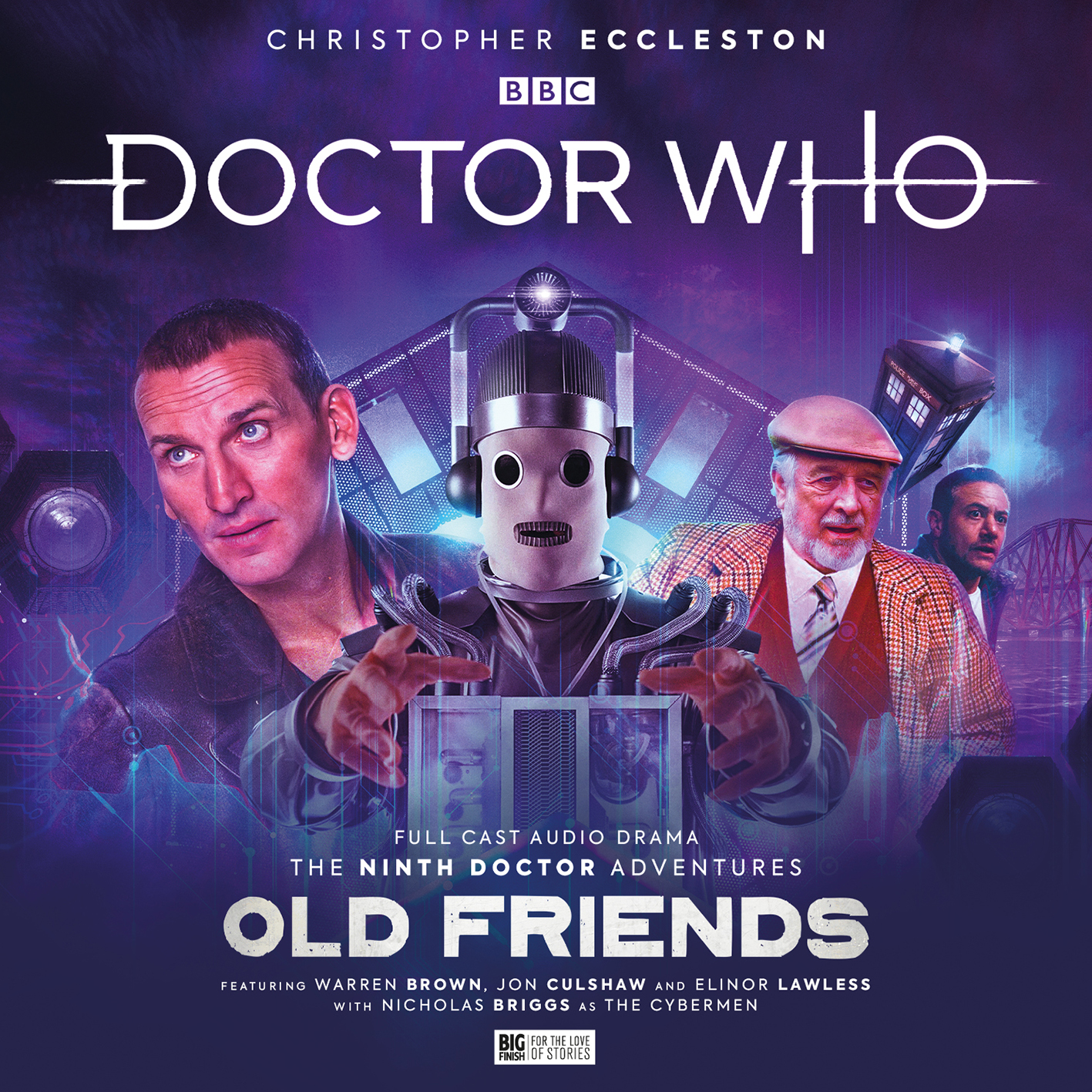
This has been a review that I’ve let percolate in my mind for a few days. The first season of The Ninth Doctor Adventures has come to a close in a perfect parallel to Series 1 and building from genuinely humble beginnings. It is also quite difficult to discuss as it’s serving as a prequel to Series 1, ending with Old Friends implying a lead into Rose. This along with Lost Warriors, and to a lesser extent Respond to All Calls, have been an examination of the Ninth Doctor’s trauma along with other characters he meets on his lonely travels. Old Friends is a contemplative box set with two stories, a single hour long episode and one two episode serial, both parallels to Boom Town and Bad Wolf/The Parting of the Ways. This has been a long time coming and is honestly an odd box set to review, because it’s a box set that almost blind sided me with what it was doing and how things ended up the way they were. The covers of the sets have been mimicking the four individual releases of Series 1, from blue to red to green to purple for the finale. This ended up being an interesting example of priming listeners for what exactly to expect with these sets.





 Indie Mac User